

Where Commercial Property Values Stand in 2026
Commercial real estate is repricing — unevenly by asset class — and for the first time in a while, sellers are meeting the market. Here’s the picture, and what it means if you’re thinking about selling.
The market is clearing again
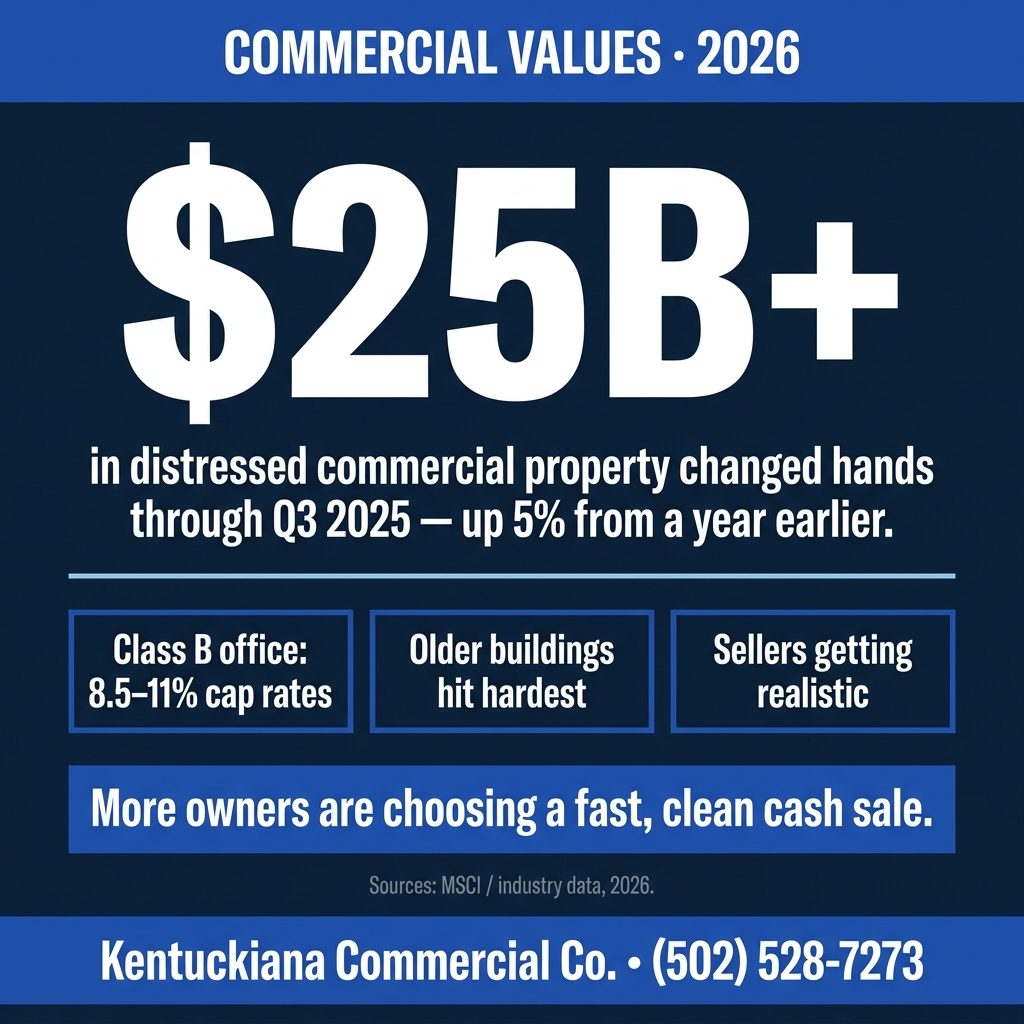
After a couple of years of buyers and sellers staring at each other across a pricing gap, deals are happening again. Through the third quarter of 2025, sales of distressed commercial property topped $25 billion — up about 5% from the same period a year earlier. New listings have climbed toward levels not seen since 2022, and the gap between what buildings appraise for and what they actually transact at has narrowed. The common thread: sellers are finally being realistic on price, and that’s what lets a market clear.
Values have reset — unevenly
“Commercial real estate” isn’t one market, and 2026 makes that obvious. Cap rates — where a higher number means a lower value — vary sharply by asset class: trophy multifamily and net-lease still compress toward 4.5–6.0%, industrial runs roughly 5.5–7.0%, and anchored retail sits around 6.5–8.0%. Office is the outlier: Class A holds near 6.0–8.0%, but Class B office has repriced to 8.5–11%. Older, “commodity” buildings have taken the hardest markdown.
Why the gap finally narrowed
Two things closed it. Sellers who once anchored to 2021 values accepted where the market actually is, and buyers — who now have a clearer read on rates and rents — came back to the table. Price discovery is painful, but it’s also how transactions resume. A repriced-but-liquid market is healthier for an owner who needs to sell than a “high” market where nothing trades.
What it means if you own
If you’re carrying a building that no longer pencils — rising taxes and insurance, stubborn vacancy, a loan you can’t refinance — a clearing market is an opening, not a reason to keep waiting for a rebound that may be years off. The owners doing well right now are the ones pricing to today and moving, not holding out for yesterday.
The case for a cash sale in this market
When you decide to exit, how you sell matters as much as when. A direct cash sale removes the two biggest risks in a soft market: financing that falls through and a marketing period that drags for months while carrying costs pile up. You get a certain closing date and a clean exit — no appraisal contingencies, no waiting on a lender, no betting on rate cuts.
How Kentuckiana Commercial Co. fits
We buy commercial property in any condition across Southern Indiana and the Louisville metro — office, retail, industrial, mixed-use, and more — for cash, as-is, on your schedule. If you want to know what your building is worth to a direct buyer in today’s market, that’s a conversation we have every week.
Questions owners are asking
Are commercial real estate values falling in 2026?
They’re repricing unevenly. Class B office has repriced to roughly 8.5–11% cap rates (lower values), while trophy multifamily and net-lease hold tighter. Older buildings have been hit hardest.
How much distressed commercial real estate is selling?
Sales of distressed commercial property exceeded $25 billion through Q3 2025, up about 5% year over year.
Is now a good time to sell?
It depends on the asset, but the market is clearing as sellers get realistic on price. A direct cash sale offers certainty without financing or long marketing risk.
Where owners go from here
Wondering what your building is worth today?
Tell us about the property and we’ll give you a straight read — and a certain, cash closing date if you want to move. Free, confidential, no obligation.